 English
 Français



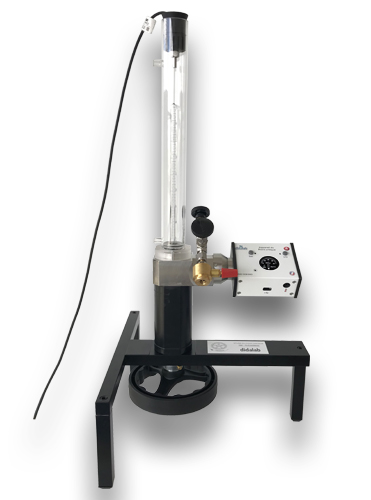


Gas critical point study : EXP300041
This experiment is designed to study gas compressibility and liquefaction (in this case the gas is sulphur hexafluoride). The device allows you to attain critical temperature and pressure. In hands-on exercises, it will be used to build the isotherm network in Clapeyron’s graph
This experiment is designed to study gas compressibility and liquefaction (in this case the gas is sulphur hexafluoride). The device allows you to attain critical temperature and pressure. In hands-on exercises, it will be used to build the isotherm network in Clapeyron’s graph. During your course demonstrations, we shall show gas liquefaction and monitor
changes in respective liquid-gas volumes during compression. We shall also show continuity of gas and liquid states above the critical point by conducting the classic critical point bypass experiment.
CLAPEYRON’S GRAPHS
Once water has been made to circulate in the plexiglas tube, set the thermostat to the required temperature. Once temperature has stabilised, start compressing the gas inside the test tube using the flywheel beneath the device. Once pressure has stabilised, read the values for Volume (V) and pressure (p). Continue to increase compression slowly and stage by stage. For each stage, read V and p, until you attain 45 bar. Repeat this exercise for increasing temperatures until 50°C is attained. You can then plot Clapeyron’s graphs.
BYPASSING THE CRITICAL POINT
Set temperature to 42°C and go to the vicinity of the critical point, i.e. roughly 35 bar. Lower pressure using the flywheel
until the liquid disappears. A liquid-gas transition will occur. Then reheat the system up to 48°C. Once this temperature
has been attained, compress the gas again up to 45 bar. No meniscus is observed. Then cool down to 42°C.Then, lower
pressure to return to the original position (i.e. 35 bar). A liquid-gas transition will once again take place. As you carry out these stages, fluid will in turn be in vapour state, hypercritical state and liquid state without it being possible at any time to observe a transition between these states.
CRITICAL OPALESCENCE
Critical opalescence is a phenomenon observed at the interface of a fluid at the vicinity of the critical point. For
this, set temperature so it attains 45°C, and increase pressure using the flywheel to approach the critical point. Once these
2 conditions have been reached, lower pressure: the light crossing the medium formed around the critical point is scattered and assumes a bluish tinge.
SUBJECTS APPROACHED
»»Clapeyron’s graphs
»»Law of corresponding states
»»Bypassing the critical point
»»Saturated vapour pressure curves
»»Critical point
»»Amagat’s diagram
»»Critical opalescence
EQUIPMENT NEEDED FOR THE EXPERIMENT
COMPOSITION
EXP 300 042 Heat capacity (BASIC)
| Reference | Description | quantity |
| PHD009960 | Critical point apparatus | 1 |
| PHD009660 | Thermostatic and water circulation bath | 1 |
COMPOSITION
EXP 300 041 Heat capacity (COMPLETE)
| Reference | Description | quantity |
| PHD009960 | Critical point apparatus | 1 |
| PHD009660 | Thermostatic and water circulation bath | 1 |
| PHD008898 | Vaccum pump | 1 |
| PHD009953 | Vaccum trap | 1 |
The vacuum pump and the vacuum trap are needed for commissioning and maintenance, not for experiments. If you want to do purchase several sets for experiments of the critical point study, you only need one of each of these two products in your laboratory.