 English
 Français



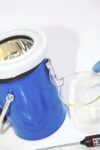
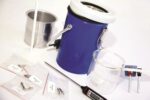


Heat capacity : EXP300030 or EXP300031
Hot metal samples are placed in a calorimeter filled with water at
low temperature. Sample heat capacity is determined based on increase in water temperature.
An amount of water, of known volume, is heated by means of resistors. Electrical heat production is thus known. Based on increase in temperature and thermal energy, the specific heat capacity of water can be calculated. Moreover, this value is corrected to allow for calorimeter heat capacity. Hot metal samples are placed in a calorimeter filled with water at
low temperature. Sample heat capacity is determined based on increase in water temperature. When parts are in contact with each other and have different heat quantities, heat is distributed until all parts have the same temperature. If heat capacities and initial temperatures are known, then final temperature can be predicted. Conversely, final temperature can be used to obtain heat capacity when the initial temperatures are known.
CALORIMETER HEAT CAPACITY
Place a certain amount of water in the Dewar flask calorimeter. Close it and insert the temperature probe. Wait for thermal
balance to be attained and note the temperature. Sample exactly the same amount of hot water and measure its temperature. Then, quickly pour this amount of hot water into the calorimeter. Close the latter, stir regularly and note the balance point temperature. As the calorimeter is adiabatic, the water is thermally insulated from the outside environment.
JOULE’S LAW AND RESISTANCE INFLUENCE
Pour a known amount of water (known weight and volumes) at ambient temperature into the calorimeter. Read water
temperature and place the chosen resistances in the sockets provided on the calorimeter cover. Switch on the power supply and set current to the required value, then stir. After a few minutes, read the new temperature value. Based on the energy conservation law and by plotting the straight line linking thermal energy as a function of time, we find the value of the resistance applied to the calorimeter.
MEASURING BRASS SPECIFIC HEAT CAPACITY
Heat water in a recipient in which a metal mass (e.g. brass) is immersed. The mass is placed on an insulator so that it is not in contact with the recipient walls. Stop heating before the water boils. Read water temperature, which is also metal temperature, and quickly plunge the mass into the calorimeter water (body of water taken from the tap at a known temperature that is generally ambient). Wait for thermal balance by stirring and measuring balance point temperature. After a few minutes, temperature will balance at a certain value, varying according to the material.
SUBJECTS APPROACHED
»»Determining the specific heat capacity of water or a liquid.
»»Determining calorimeter heat capacity
»»Determining the specific heat capacity of aluminium, iron and brass
»»Joule’s law
NECESSARY EQUIPMENT
COMPOSITION
EXP 300 031 Heat capacity (BASIC)
| Reference | Description | quantity |
| PTD039505 | Dewar calorimeter | 1 |
| PTD039504 | Metallic cubes (4 different metals) | 1 |
| PEM080100 | Set of 2 Ø 4-mm cords, 1 m (1 red/ 1 black) | 3 |
COMPOSITION
EXP 300 030 Heat capacity (COMPLETE)
| Reference | Description | quantity |
| PTD039505 | Dewar calorimeter | 1 |
| PTD039504 | Metallic cubes (4 different metals) | 1 |
| PMM062603 | Power supply, 0-30 V /0-10 A | 1 |
| PMM062901 | Digital multimeter | 1 |
| PEM080100 | Set of 2 Ø 4-mm cords, 1 m (1 red/ 1 black) | 3 |